


For years, Southeast Asia was one of the most important consumption hubs for K-pop and Western pop music. The Philippines, Indonesia, and Thailand consistently fueled global streaming numbers, online engagement, and digital fan culture for artists from Seoul and the West. These countries were not just casual listeners; they became essential pillars of the global music ecosystem. But beginning in 2024, a noticeable shift started taking shape across the region. The “Big Three” of Southeast Asia began choosing themselves.
Recent Spotify Daily Charts point to a growing localization movement in which domestic artists are increasingly dominating their own markets. What once seemed like temporary bursts of national support has evolved into a broader cultural realignment. Local audiences are no longer only consuming imported entertainment at massive scale, they are actively building their own industries into mainstream cultural forces.
Indonesia has become one of the clearest examples of this transition. Local Indo Pop, especially emotionally driven ballads and mellow love songs, now consistently outperforms many global releases on streaming charts. Indonesian listeners appear to be gravitating toward music that reflects their own emotional language and cultural experiences. The success of these tracks suggests that familiarity and emotional resonance are beginning to outweigh the prestige traditionally associated with international acts.
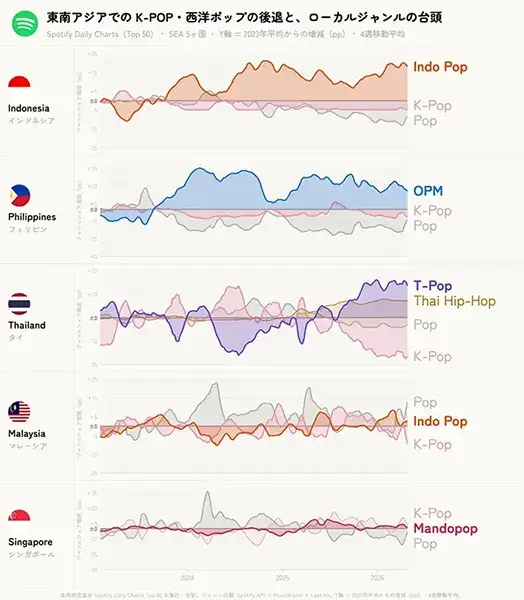
Thailand’s transformation has taken a different shape. T-pop and Thai hip-hop have experienced a major cultural surge, with Bangkok increasingly becoming its own center of youth identity and musical influence. The sense of trendiness and aspirational culture once associated almost exclusively with Korean entertainment is now being recreated locally through Thai artists, fashion, and street culture. Rather than simply following global trends, Thai music has started building a distinctly local version of modern pop stardom.
The Philippines, however, may represent the most dramatic shift of all. OPM (original Pilipino music) did not simply gain momentum, it exploded into mainstream dominance beginning in 2024. Acts such as BINI, SB19, TJ Monterde, and Cup of Joe became increasingly visible across Spotify Daily Charts, social media trends, sold-out events, and online fan spaces. In many cases, local releases began occupying large portions of viral rankings and daily streaming charts that were once heavily dominated by foreign acts.
What makes the Philippine shift especially significant is the infrastructure behind it. Filipino fans were among the pioneers of modern digital fandom culture long before OPM’s recent resurgence. They helped normalize organized streaming parties, mass voting campaigns, coordinated hashtag trends, fan edits, and English-language online promotion that helped K-pop spread internationally. Alongside Indonesian fans, Filipinos became known as part of the “machinery” behind the global expansion of Korean pop culture.
Now, that machinery is being redirected inward. Instead of focusing exclusively on imported idols, Filipino audiences are increasingly applying the same level of organization, loyalty, and digital engagement to local artists. The systems that once amplified foreign acts are now strengthening the visibility of OPM. Fanbases organize streaming goals, dominate online conversations, create promotional content, and mobilize communities with the same intensity once reserved almost entirely for K-pop comebacks.
OPM’s rise is not solely the result of fandom culture. The industry itself has evolved. Production quality has improved significantly, idol training systems have become more refined, and Filipino artists have become increasingly effective at navigating social media and modern music marketing. Local acts now compete with international artists not only through national support, but through polished branding, performance quality, and a stronger understanding of digital audiences.
This broader shift across Southeast Asia does not mean K-pop or Western pop are disappearing. Both remain enormously influential throughout the region. However, their era of uncontested dominance may be weakening as domestic industries become more culturally confident and commercially competitive.