

The death of 80-year-old automotive magnate Tang Aoqi 唐敖齐 sent a shockwave through China’s manufacturing community, but it was the unexpected response of his wife, Zhu Yuqin, that sparked a sweeping national debate on wealth succession. Her decision to renounce her inheritance and give all of her equity to her two children not only reshaped control of the family’s business empire but also became a rare case study in how Chinese private enterprises can pass the baton without conflict.
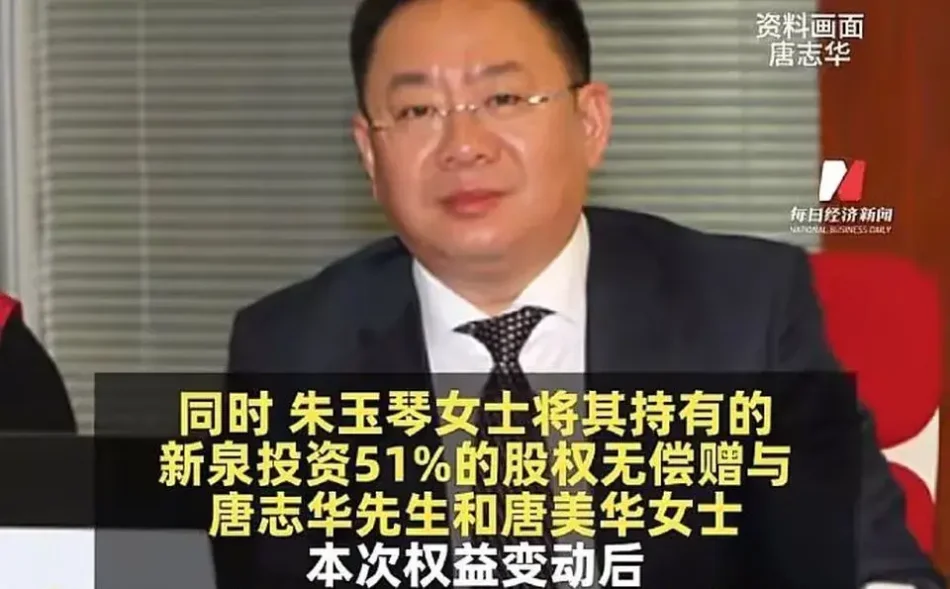
Tang Aoqi, the founder and one of the actual controllers of Jiangsu Xinquan Automotive Trim Co.,Ltd., passed away on October 26, 2025. When Tang passed away, he held 51% of Xinquan Investment’s shares. Half of that stake, 25.5%, legally belonged to his wife as marital property, while the remaining 25.5% formed the estate to be inherited jointly by Zhu and their children, Tang Zhihua and Tang Meihua. Zhu’s move was as decisive as it was unusual: she gave up her right to inherit and then transferred all of her own 25.5% stake to the children as a tax-free gift, splitting the equity down the middle. Each child ended up with 12.75% of Xinquan Investment’s shares, equivalent to roughly 1.1 billion yuan based on market value.
Despite the appearance of equal treatment, the redistribution ultimately consolidated power in the hands of their son. After the restructuring, Tang Zhihua controlled 27.26% of Xinquan Shares through both direct and indirect holdings, making him the company’s new de facto controller. His sister, by contrast, held a modest 8.13% and did not enter core management. For the company, the transition was smooth: the 54-year-old Tang Zhihua had long served as chairman and CEO as a co-founder, ensuring continuity in governance and strategy.

Public reaction centered on three tensions revealed by the case. The first was the gap between “equal shares” and “real authority”. Although both siblings received the same economic interests, only one emerged with decision-making power. Many commentators praised this arrangement as a pragmatic blend of fairness and efficiency, formal equality for family harmony, functional hierarchy for corporate stability.
The second point of fascination was Zhu Yuqin’s unconventional choice. To some, she became a symbol of selflessness, putting her children’s long-term interests above personal gain and preventing the kind of inheritance battles often seen in wealthy families. Analysts also noted that her decision significantly reduced the tax burden of succession. China has no inheritance tax, and qualified transfers of equity among immediate family members are exempt from personal income tax. Had the transfer been taxed at a 20% capital gains rate, the family might have lost billions.
The third area of debate touched on the broader implications for private enterprise succession. Compared with high-profile disputes such as the protracted inheritance battles of the Stanley Ho family or the governance chaos around the Ningbo Shanshan Group, the Tang family demonstrated an almost seamless transition. Observers attributed this to a combination of clear legal structuring, marital property delineation, inheritance waiver, and gifting, along with a capable successor already embedded in the business, and an early awareness of risks. Still, some warned that splitting equity among heirs could create governance challenges later unless complemented by mechanisms such as a family constitution.
The episode also rippled through the automotive supply chain. Jiangsu Xinquan Automotive, a key interior supplier to Tesla, had seen its stock surge more than 60% this year, lifting its market value to 34.9 billion yuan. Investors closely watched whether the change in ultimate control might disrupt partnerships or operations. The company maintained that business continuity would be unaffected, and the market so far appears to agree.
At a policy level, the discussion revived concerns about China’s future taxation framework. Should the country one day introduce an inheritance tax? International examples such as the U.S. reach rates as high as 50%; wealthy families may increasingly turn to tools such as offshore trusts or philanthropic structures. Warren Buffett’s recent revision of his will, directing $1.3 billion into a new charitable trust managed by his three children to minimize tax exposure, was frequently cited as a telling parallel.
In the end, the Tang family’s succession plan illustrates a delicate balancing act between commercial rationality and familial ethics. Its success rested on three pillars: the founder’s early planning, the successor’s proven legitimacy, and the flexible use of legal tools. Remove any one of these, and the story might have unfolded very differently.