
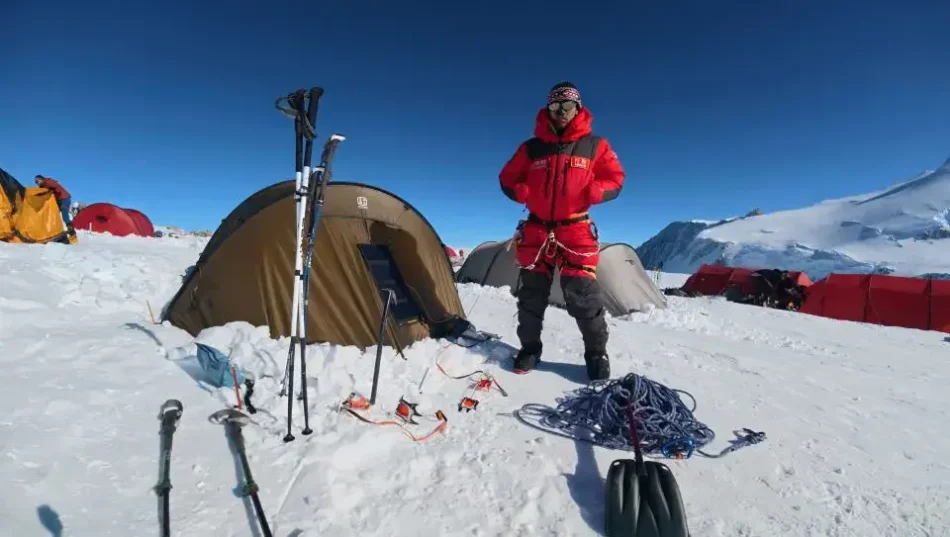

On the night of December 1, 2025, at 21:20, Chinese mountaineer Hans (Hu Guo Heng 胡国亨) 汗斯, born in Gansu, stood atop Vinson Massif in Antarctica, completing the last and most remote chapter of his quest to climb the highest peaks on all seven continents. In temperatures plummeting to –60°C and winds exceeding 100 kilometers per hour, he reached the 4,892 meters summit and descended safely, marking a historic first for China’s civilian exploration community. His achievement not only fills a long-standing gap in China’s mountaineering history but also positions him as a landmark figure in grassroots adventure.
This final ascent came only after extraordinary challenges unique to the “cold pole of the Earth”. Although Antarctica was in its season of polar daylight, the environment remained brutally hostile, with deep crevasses hidden beneath windswept snowfields. A forecast of escalating winds forced Hans and his team to abandon their original plan to summit on December 2. Instead, they launched an emergency push, climbing continuously for seven hours. The gamble paid off, allowing them to stand on the continent’s highest point before the weather closed in again.
Hans’s journey to this moment had been remarkably condensed. In May 2025 he summited Mount Everest, the 8,848.86-meter giant of Asia. In June he moved on to North America’s Denali, one of the most demanding climbs of the Seven Summits due to its latitude and weather. By December he had reached the end of his half-year expedition cycle on the frozen heights of Vinson Massif.
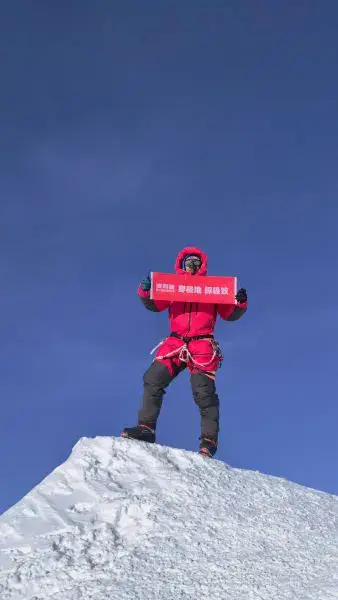
Critical to his success was the specialized equipment designed to withstand Antarctica’s deadly cold. Throughout the expedition he wore the sixth-generation Polar Extreme Cold down suit developed by Bosideng, capable of resisting temperatures below –60°C. The same system is used by China’s 42nd Antarctic scientific research team and is engineered to deliver triple protection, against extreme wind, heat loss, and moisture buildup. Bosideng’s participation extended beyond simple sponsorship: since 1998 the brand has supported China’s polar research missions, and this ascent provided a new global demonstration of its technical competence in high-performance thermal gear.
The response back home has been one of pride, reflection, and renewed enthusiasm for exploration. Media commentators have emphasized that Hans’s success represents more than an individual milestone, it symbolizes a rising spirit of civilian adventure in China, grounded in humility before nature and perseverance in the face of hardship. Online, many people have taken the metaphor further, comparing climbing to life’s own low moments and praising the courage required to surpass them. Outdoor enthusiasts have also highlighted how innovations first developed for polar research are now available to everyday consumers, making the resilience needed for harsh environments, literal or figurative, more accessible than ever.
In completing the Seven Summits under some of the harshest conditions on Earth, Hans has carved out a chapter of exploration that resonates far beyond mountaineering. His story speaks to the human instinct to push limits, the value of technological support in extreme contexts, and the shared aspiration to rise above challenges, no matter how cold the world may feel.