
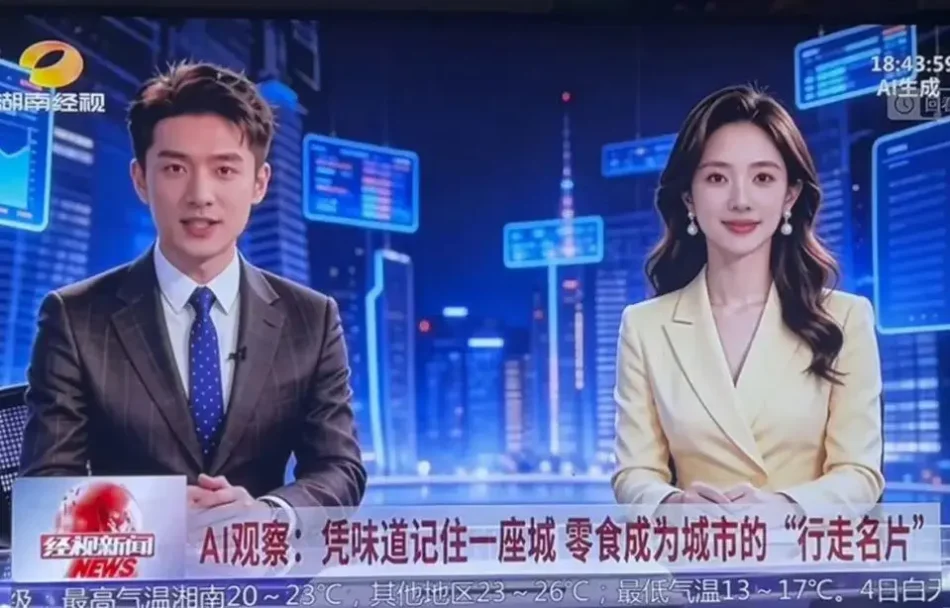

Starting May 1, 2026, Hunan Economic Television’s Jingshi News 《经视新闻》 officially introduced two AI news anchors, “Shengsheng” 生生 and “Shuangshuang” 双双, marking a notable step toward round-the-clock automation combined with human–machine collaboration in broadcast journalism. This shift does not signal the complete replacement of human presenters. Instead, it establishes a hybrid model in which AI handles standardized, time-sensitive tasks such as hourly bulletins, weather updates, and rolling news feeds, while human reporters and anchors remain responsible for in-depth reporting, interviews, and on-the-ground coverage of breaking events. To maintain transparency, broadcasts clearly display an “AI-generated” label in the corner of the screen, and AI-driven directing systems are used to automate visual transitions. The initiative builds on earlier experimentation, including the introduction of a digital host that helped accumulate technical experience for this more normalized deployment.
Hunan Broadcasting has been investing in AI for some time, and the current system is powered by its proprietary “Mango LLM”. This platform has already produced more than 80 intelligent agents and has been integrated into the workflows of over 30 television programs. The results are measurable: production efficiency has increased by more than 30%, while costs, especially for late-night news, have dropped significantly, in some cases by around 70%. AI anchors can operate continuously without fatigue, maintaining consistent delivery in tone, pace, and appearance. They avoid common human errors such as slips of the tongue or emotional inconsistency, making them particularly suitable for formal, standardized news content.
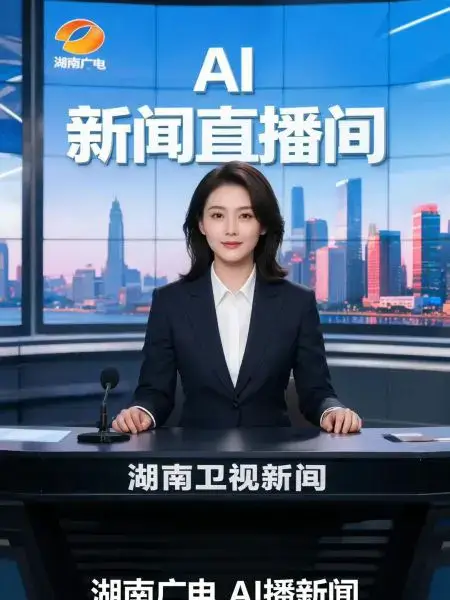
Many viewers express amazement at the rapid pace of technological progress, noting how scenarios once imagined in television dramas have quickly become reality. At the same time, concerns have emerged about the emotional limitations of AI presenters. While visually polished and technically precise, they are often described as lacking warmth and genuine human feeling, qualities that are especially important in coverage of disasters or stories involving everyday life. There is also unease about the potential impact on employment, particularly among those studying broadcasting and media. Some commentators argue that mainstream media organizations should proceed cautiously, as public anxiety about job displacement remains high.
Others take a more balanced view, suggesting that AI’s strengths lie in handling repetitive, structured tasks, thereby freeing human journalists to focus on investigative work, storytelling, and emotional engagement. From this perspective, the most sustainable future is one in which humans remain in control while AI serves as a tool that enhances productivity and consistency.
The emergence of AI in news production also raises important questions about ethics and professional boundaries. Transparent labeling of AI-generated content is increasingly seen as a minimum requirement to maintain public trust. At its core, journalism depends on truth, depth, and human empathy, qualities that technology alone cannot fully replicate. AI can extend the reach and efficiency of news organizations, but it cannot replace the interpretive judgment and moral responsibility of human professionals. The industry must therefore navigate challenges such as defining the limits of AI-generated content, preventing misinformation, avoiding copyright violations, and establishing clear accountability when errors occur. The long-term direction appears to favor a complementary relationship: embracing technological innovation while preserving the human values that give journalism its meaning.