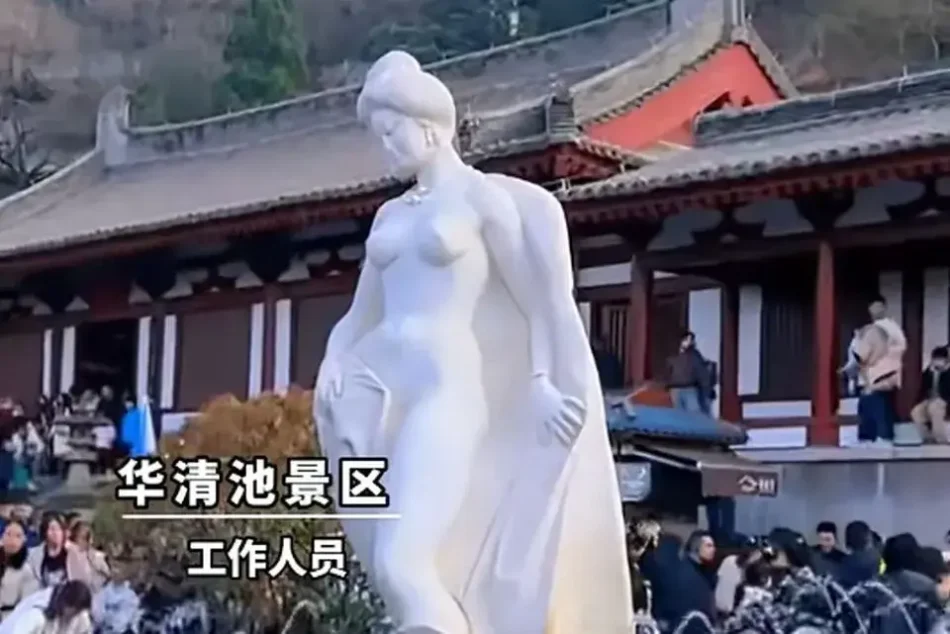

For more than thirty five years, a semi-nude sculpture depicting “Lady Yang Bathing” 贵妃出浴 has stood at Huaqing Pool in Xi’an, largely unnoticed by controversy. Recently, however, it has become the center of heated online debate, with some netizens accusing the work of being “indecent”. What might have remained a quiet piece of public art has instead ignited a broader argument over the boundaries of artistic expression, the representation of historical figures, and the clash of values in contemporary Chinese society.
Those calling for the sculpture’s removal frame their objections in moral, cultural, and ethical terms. Some argue that portraying Yang Guifei, an iconic historical figure, in a semi-nude form undermines her dignity and departs from the traditional Chinese aesthetic of subtlety and restraint, often summarized by the phrase “implicit beauty”. In their view, exposing the body of a real historical person crosses a line that fictional or mythological figures do not. Others raise concerns about public morality, pointing to inappropriate behavior by a small number of tourists and worrying about the influence such imagery might have on minors in a public space. There are also criticisms that the sculpture’s realistic style borrows too heavily from Western traditions of nude statuary, making it feel out of place in a Tang dynasty–themed imperial garden and culturally “misaligned”.
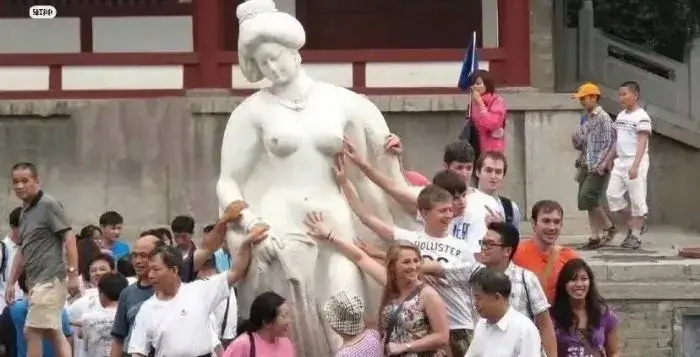
Supporters of the sculpture counter these claims by emphasizing its artistic and historical legitimacy. Created in 1991 by the renowned sculptor Pan He 潘鹤 and approved at the time by relevant cultural authorities, the work was intended to visualize the famous line from Bai Juyi’s poetry describing the smooth waters of the hot springs washing over Yang Guifei’s skin. Defenders note that nudity in art is not alien to Chinese tradition: Han dynasty murals and Dunhuang cave art contain numerous examples of unclothed or semi-clothed figures, and the Tang dynasty itself is widely remembered for its cultural openness. From this perspective, the sculpture reflects a historically grounded aesthetic rather than a provocation. Many also point out what they see as a double standard: Western nude masterpieces such as Venus or David are routinely celebrated as high art, while a Chinese work exploring similar themes is dismissed as vulgar.
Public opinion appears sharply divided, though a large number of voices online argue that the controversy itself signals a kind of cultural regression. They note that a sculpture deemed acceptable in the early years of reform and opening-up is now being questioned decades later, and mock the idea that social tolerance has shrunk rather than expanded. Some commentators urge the site’s administrators to adopt a “cold treatment” approach, neither responding to nor acting on the criticism, warning that overreaction would only amplify fringe opinions. Influential commentators have gone further, suggesting that removing the sculpture would symbolize a retreat from the openness and confidence cultivated over the past several decades.
Some have proposed compromise solutions, such as adding explanatory plaques to better contextualize the sculpture’s literary and historical background, or adjusting its placement to balance artistic intent with public sensitivity. Others suggest developing a more nuanced system for evaluating public art, one that considers location and audience rather than relying on blunt measures like removal.