
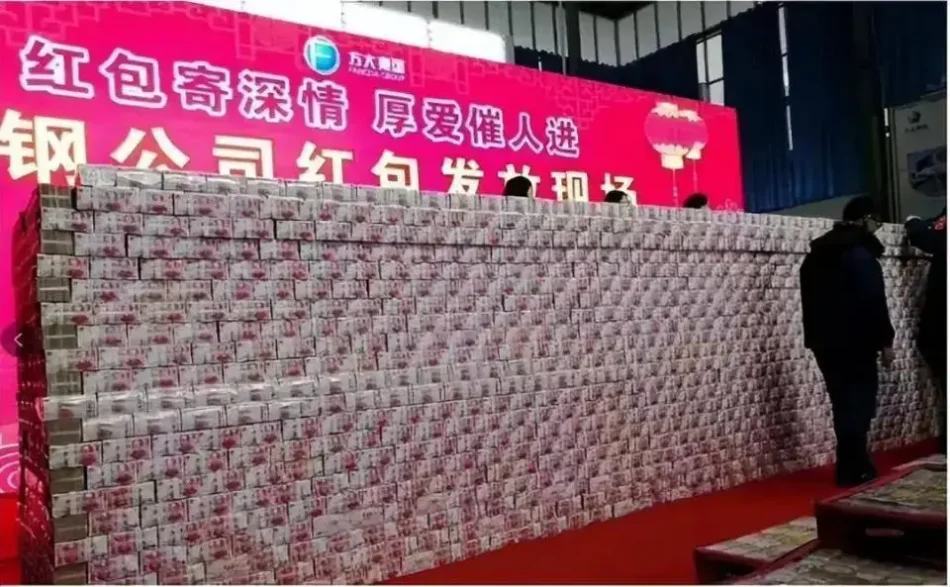

At the end of every year, few moments matter more to Chinese workers than the annual bonus. At Fangda Group 方大集团, that ritual has turned into a spectacle: walls of cash built from stacks of 100 yuan banknotes, employees lining up to receive red envelopes in scenes that look staged for television but are entirely real.
Behind the spectacle stands Fang Wei 方威, the low-profile chairman often dubbed the “red envelope tycoon” of Northeast China. Over the past decade, Fangda has distributed nearly 4 billion yuan in cash bonuses to its 130,000 employees. At the same time, Fang Wei’s personal fortune has continued to climb. On the 2025 Hurun Rich List, his wealth surged to 52.5 billion yuan, up 12 billion from the previous year, securing his position as the richest entrepreneur in China’s three northeastern provinces. Giving generously while getting richer has become his defining business paradox.
Fang’s story began far from any cash wall. Born in 1973 in suburban Shenyang, he grew up collecting scrap metal with his father. As a teenager, he travelled across Liaoning sourcing waste steel and reselling it to mills, developing an instinct for price cycles and supply gaps. A pivotal moment came when a steel plant repaid debt with iron ore instead of cash. Fang accepted the risk; years later, soaring ore prices delivered his first major fortune.
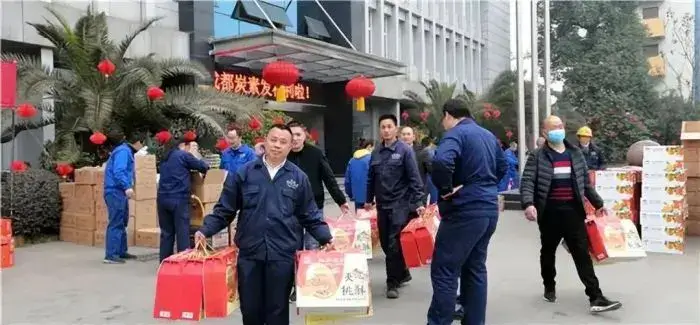
In the early 2000s, he formalized what would become the “Fangda model”: acquire distressed state-owned enterprises, restore profitability, and integrate them into a broader industrial chain. Starting with a struggling carbon plant in Fushun, he expanded into steel, mining, pharmaceuticals and commerce. In 2009, he took control of Nanchang Steel, later renamed Fangda Special Steel. In 2018, he entered the pharmaceutical sector by acquiring Northeast Pharmaceutical. In 2021, he stunned the market by investing 41 billion yuan to restructure the aviation assets of HNA Group, pledging not to cut jobs or salaries. Within three months, wage arrears were cleared and over 300 million yuan in bonuses were distributed to more than 60,000 employees. By the first three quarters of 2025, the restructured airline business had returned to solid profitability, outperforming several listed peers.
Fangda has built what many call one of the most hardcore welfare systems among Chinese private enterprises. Its “nine major benefits” cover employees and their families: medical assistance, major illness relief, education scholarships, parental subsidies, pension supplements and more. Equity incentives tilt toward frontline backbone staff, binding ordinary workers’ income to corporate market value. The famous 2020 episode, when over 4,000 steelworkers each received a car with five years of insurance and taxes covered, cemented Fang’s reputation nationwide. Beyond the company, Fangda’s cumulative philanthropic donations have exceeded 5.5 billion yuan.
From scrap collector to steel magnate, from serial state enterprise restructurer to aviation rescuer, Fang Wei has built a five pillar industrial empire spanning carbon materials, steel, pharmaceuticals, commerce and aviation. His formula remains consistent: acquire at the bottom, inject disciplined management, implement competitive internal mechanisms, and “distribute wealth to gather people”.
The duality of Fangda is striking. It is both a benchmark for employee welfare, nearly 4 billion yuan in bonuses over ten years, and an aggressive capital player whose expansions are often high stakes gambles. In an era when capital is often accused of indifference, Fang’s approach suggests a different equation: money can fuel expansion, but loyalty and morale are cultivated through sharing. Whether the “Fangda model” can continue to thrive amid tighter liquidity and shifting industrial winds remains to be seen. What is certain is that the man who once carried a sack of scrap metal now carries the weight of 130,000 livelihoods, and still believes that prosperity is most powerful when it is passed around.