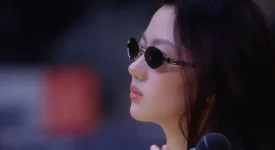


Han Anran 韩安冉 recently revealed that her pay for acting in short form series has fallen off a cliff, dropping from a daily rate of 5,000 yuan to just 500 yuan. Paired with an average workload of nearly 20 hours a day, the contrast quickly ignited heated discussion online, touching on her reasons for transitioning careers, the inner workings of the short drama industry, and the stark income gaps between internet celebrities and ordinary performers.
According to Han, she earned 5,000 yuan per day on her previous short drama, taking home about 15,000 yuan for three days of work before a 10% agency commission. Her latest project, filmed in Hengdian, pays only 500 yuan per day, a 90% cut. She explained that the new production is considered a “sure hit, big budget” project, and that newcomers are often expected to start at a low price. What shocked many viewers even more than the pay cut was the intensity of the schedule. Filming reportedly ran 18 to 20 hours a day, leaving her with only about 10 hours of sleep over three days. Calculated by the hour, her pay dropped to roughly 25 yuan per hour, far below what she can earn from a single livestream sales session.

The comparison became even sharper when netizens recalled earlier discussions about her husband, Song Haoran 宋浩然, who was said to have earned 7,000 yuan for a three-day shoot with only five lines of dialogue and still felt underpaid.
Han has been candid about why she is willing to endure such conditions. One motivation, she said, is to prove her real appearance in dynamic camera shots, pushing back against long-standing accusations that she relies heavily on beauty filters and has a “manufactured” look in livestreams. More pragmatically, she admitted that acting in short dramas earns her less than one-tenth of what she makes from e-commerce livestreaming. The real value, in her view, lies in exposure. Appearing in a highly anticipated short drama can generate buzz that later funnels viewers back to her online shops, forming a loop of “short drama for traffic, livestreams for cash”. Her new role in a revenge-themed series, whose storyline mirrors aspects of her own controversial public life, seems designed to capitalize on exactly that kind of attention.
Her experience has also reignited debate about the broader short drama industry. Cities like Xi’an have become production hubs, accounting for a large share of the country’s output, with an assembly-line model that can churn out 30 to 40 episodes in under a week. Han’s new project reportedly followed an extreme “three-day shoot” approach, relying on high conflict plots such as family feuds and revenge to hook viewers quickly. Critics argue that this speed comes at a cost. Long hours, minimal rest, and contracts that sidestep overtime compensation raise concerns about performers’ health and rights, even as rumors of extreme conditions circulate and are repeatedly denied or left unverified.
Traffic and visibility can open doors, but they do not replace the professional demands of acting, from line delivery to emotional range. Han herself has acknowledged limits, joking that she will not do kissing scenes unless the male lead is handsome enough. At the same time, the industry’s commercial logic remains dominant: a handful of top actors can earn millions through revenue sharing, while most performers work long hours for modest pay. The label of a “sure-hit” drama paired with bargain basement wages exposes how heavily resources are tilted toward perceived traffic value, leaving many on set to shoulder the costs of speed and risk.