
At the beginning of 2026, a breakthrough in AI-generated actors sparked intense debate across China’s internet. The new generation of digital performers has become so realistic that audiences can scarcely distinguish them from real people. In one widely discussed case, even family members of veteran actor Wang Jinsong 王劲松 reportedly failed to recognize that a circulating video of him was AI-fabricated. What began as a technological milestone has quickly evolved into a profound reckoning for the film and television industry, and a broader ethical storm.
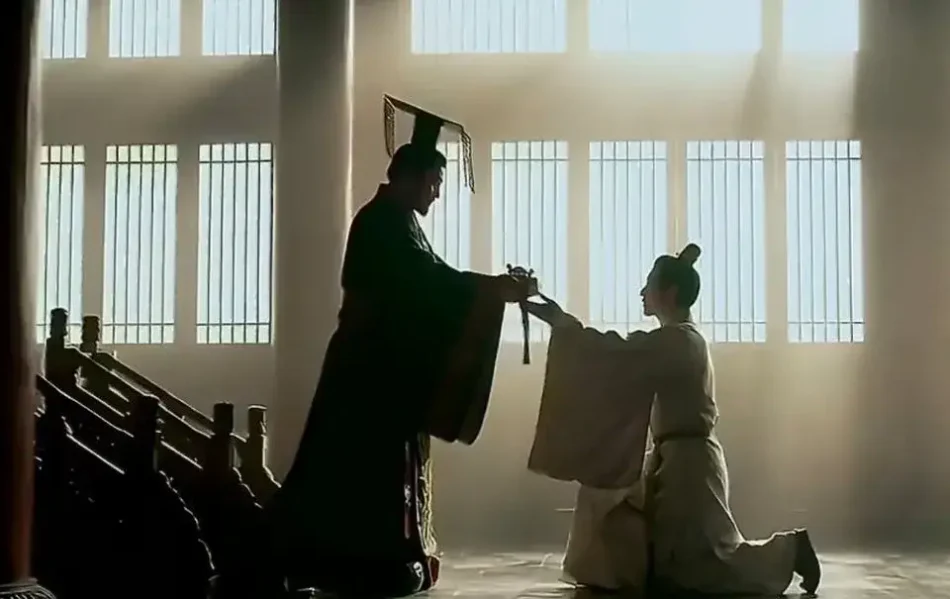
AI actors have moved beyond the once criticized “plastic” look into near seamless realism. Supported by 4D light field modeling and neural rendering, they now reproduce millimeter level skin textures, subtle muscle movements, and even the way tears pull at facial expressions. In the short drama, pupils contract naturally with shifting light, and flowing ancient costumes respond convincingly to gravity and motion. The longstanding challenge of maintaining facial consistency across multiple camera angles has largely been solved. Many viewers report needing half an episode before realizing the lead character is not human.
The production cost of a single short drama episode has dropped from around 50,000 yuan to just a few thousand; a five second close-up can cost as little as three yuan to generate. By inputting a script, creators can automatically produce storyboards, characters, voiceovers, and special effects. With tools such as Seedance 3.0, one person can generate up to 18 minutes of film-grade video in a single session, complete with multilingual dubbing. Processes that once required months of shooting can now be completed in days. Some teams of three claim to produce 80 episodes in five days, an efficiency nearly a hundred times greater than traditional production.

AI short dramas now cost as little as 3,000 to 5,000 yuan per project, roughly 1% of the budget of a conventional live-action series, which typically ranges from 500,000 to 1 million yuan. While premium AI projects may reach 200,000 yuan, they still undercut human productions by a wide margin. The result is a stark “dual-track” industry: AI dramas are booming while many live-action projects are halted or canceled.
During the 2026 Spring Festival holiday, AI drama “The Supreme Martial Sage 2 Chapter of the Divine Realm” 武极天尊神界篇 surpassed 100 million views. Meanwhile, more than 90% of short live-action dramas struggled to turn a profit, prompting major platforms to reduce guaranteed revenue sharing models and shift investment toward AI-driven content.
AI actors, requiring no salary, immune to scandal, and capable of working around the clock, are replacing extras, stunt doubles, and formulaic idol drama roles. Mid-tier actors face a “downgrade crisis” as standards rise to demand both strong acting skills and visual appeal. While top-tier performers may still command daily fees of 50,000 yuan, overall production volume is shrinking, deflating the previous salary bubble.
Directors increasingly function as AI calibration specialists, mastering prompt engineering and algorithmic optimization rather than directing performers on set. Their workflow shifts toward “anchoring the first and last frames” while letting algorithms interpolate the rest. Screenwriters experience polarization: demand for high-quality storytelling has surged, but assembly line writers reliant on repetitive tropes, such as rebirth and revenge plots, face elimination. The core competitive advantage is moving from execution to imagination.
Although AI can replicate microexpressions, it often struggles with improvisation, emotional buildup in long takes, and subtle physiological rhythms. Teachers at the Central Academy of Drama argue that the “living breath” of a human performer, breathing patterns, unconscious tremors, and instinctive gestures shaped by lived experience, cannot be fully encoded into algorithms. As actor Yang Haoyu said, “AI can imitate Zhuge Liang’s facial expressions, but it cannot comprehend the scholar-official spirit embodied in the phrase ‘Give one’s all till one’s heart stops beating’.”
China’s Interim Measures for the Management of Generative Artificial Intelligence Services 《生成式人工智能服务管理暂行办法》 require traceable watermarks for AI-generated content and imposes penalties for malicious deepfakes. Industry oversight has tightened, eliminating speculative “produce ten, hope one succeeds” models and pushing companies toward compliance and quality.
The future appears to lie in coexistence rather than total replacement. AI is likely to dominate fast consumption genres, formulaic fantasy, large-scale war scenes, and mass-produced content, while human actors focus on realism, theatre, and emotionally demanding narratives. Audience surveys suggest that while about 60% of young viewers accept AI performances in short dramas, roughly 70% insist that realist themes require genuine emotion and real intimacy.
When technology can replicate a face but struggles to capture a soul, the essence of storytelling returns to human depth. Rather than signaling the end of actors, this transformation may filter out superficial performances and elevate those shaped by authentic experience. In that sense, the AI revolution is not an apocalypse for the industry, but a crucible, one that tests what it truly means to perform.