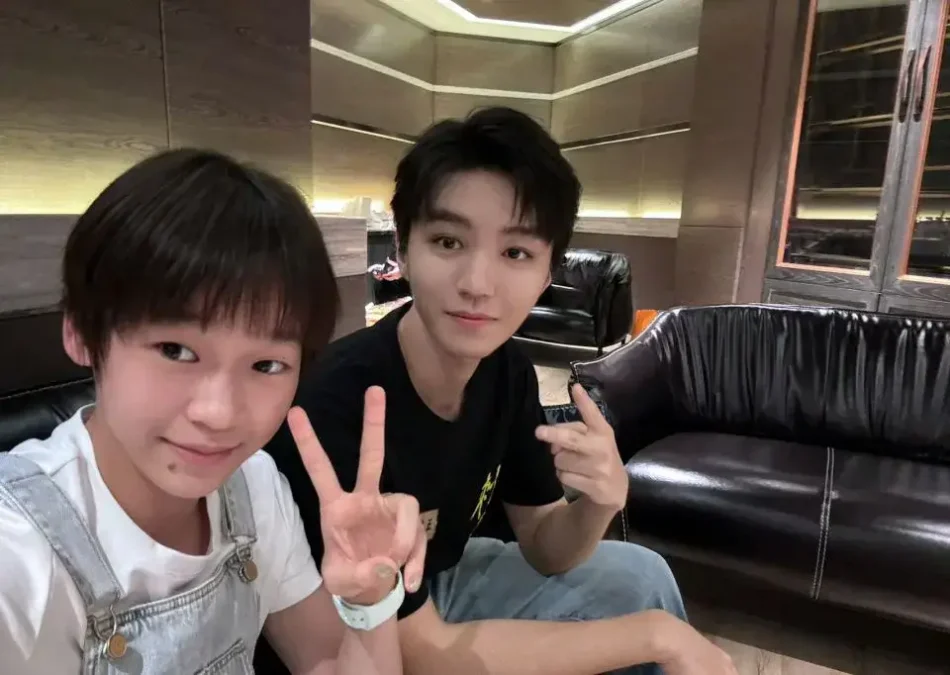

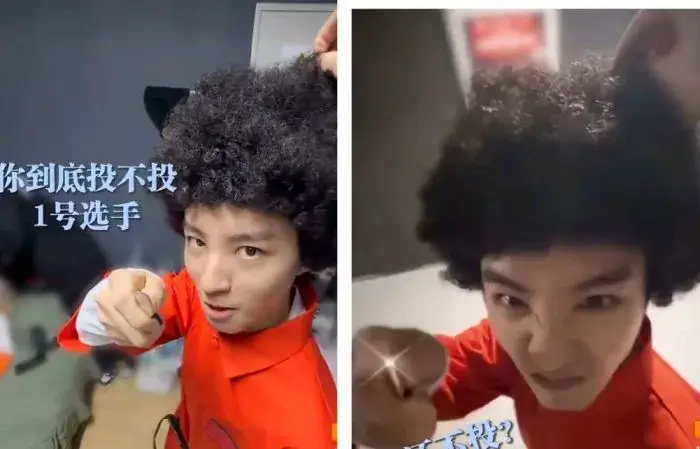
An unexpected wave of controversy recently surrounded Wang Junkai 王俊凯 after a lighthearted backstage video with Olympic diving champion Quan Hongchan 全红婵 began circulating online. In the clip, Wang appears in a rare, relaxed state, joking around with a comically fluffy wig, playfully posing with props, and laughing without the restraint audiences have grown used to. What was meant to be a harmless moment of humor instead triggered emotional turbulence among some fans, ultimately sparking a small but loud “unfollowing” movement. Beneath the surface, however, the dispute reveals a deeper and more structural tension: the painful renegotiation of relationships when an idol long perceived as growing up alongside their audience steps into a more professionally bounded artistic identity.
The video was posted by Quan Hongchan on December 15, 2025, showing the backstage of a stage play. For many viewers, the shock did not lie in the interaction itself, nor in speculation about romance or gender dynamics. Rather, it was the contrast. Some fans felt that the vividness, looseness, and spontaneity Wang displayed toward a friend had rarely been shown to fans in recent years. Compared with his increasingly restrained public appearances, mostly limited to formal promotions and work-related updates, this sudden glimpse of liveliness created a sense of emotional imbalance. The feeling was not jealousy but displacement: why did this version of him seem reserved for others?
Those choosing to step away were quick to clarify that their disappointment was not aimed at Quan Hongchan, nor rooted in possessiveness. Instead, they pointed to a gradual erosion of what they once perceived as mutual emotional investment. Since around 2023, birthday auto replies disappeared, holiday greetings became infrequent, and casual daily sharing nearly vanished. For fans who had grown up alongside Wang in a classic “training-based” idol model, the relationship had long been built on intimacy, responsiveness, and a sense of shared time. When that feedback loop weakened, some felt that the original emotional contract had quietly expired.
At the heart of the debate lies a mismatch between expectation and transformation. From the fans’ perspective, they hoped for the continuation of earlier interaction patterns, live birthday broadcasts, affectionate messages, frequent informal updates. From Wang’s side, however, his professional trajectory has clearly shifted. In recent years, his focus has moved decisively toward theater and film, with public appearances largely serving the promotion of work rather than personal connection. His studio has emphasized that interaction has not disappeared entirely in 2025, citing monthly touchpoints such as customized fan support items, behind-the-scenes shares from film sets, and concentrated birthday content. The difference, they argue, lies not in frequency but in form: less emotional companionship, more concrete, action-based care.
Supporters argue that Wang has always expressed sincerity through actions rather than words. They point to moments such as his emotional tears during theater curtain calls, his insistence on refunding ticket price differences during roadshows, and his meticulous bows to all sides of the stage. In their eyes, these gestures reflect a consistent moral core, one that prioritizes professionalism, respect, and tangible responsibility over performative closeness. They also stress that an artist has the right to draw boundaries between work and private life, and that casual interactions with friends are neither betrayals nor obligations to be shared equally with fans.
Others maintain that fandom is built on emotional reciprocity. They argue that when fans invest time, money, and feeling, they naturally hope for acknowledgment that goes beyond polished professionalism. From this angle, Wang’s growing emotional reserve feels less like maturity and more like distance. Between these positions stands a more neutral voice, observing that such fractures are almost inevitable when an idol transitions into a serious actor. One side seeks depth and artistic sedimentation; the other longs for warmth and immediacy. When those needs diverge, separation can feel both painful and unavoidable.
Ultimately, the quiet truth of growth is: relationships must be redefined as people change.