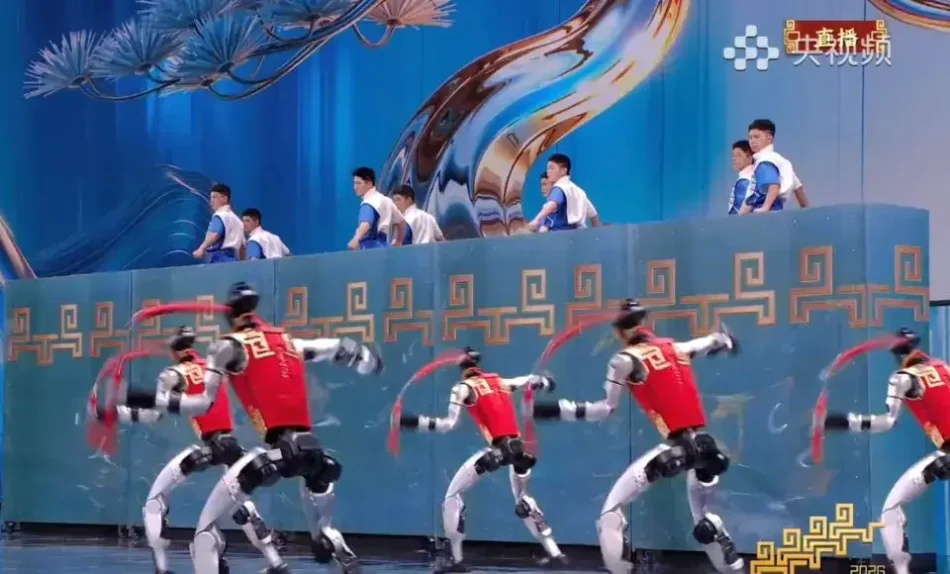

The robot performance at the 2026 Spring Festival Gala sparked sharply divided reactions among Taiwanese netizens. While many viewers were stunned by the difficulty of the movements and the overwhelming sense of technological sophistication, describing it as “explosive” and “mind-blowing”, others appeared visibly shaken, some even convincing themselves that “it must all be special effects”.
The highlight of the evening was the martial arts themed program “Wu Bot” 《武BOT》 presented by Unitree 宇树科技. The robots executed drunken boxing routines, swung nunchaku, performed consecutive backflips, and vaulted with remarkable precision and fluidity. Taiwanese viewers expressed amazement, commenting that the performance “completely exceeded imagination” and that “the mainland’s technological progress is breathtaking”. What struck many most was the speed of development, in just one year, robots that had previously performed simple folk dances appeared to have evolved into “kung fu masters”.
Families in Taipei reportedly made a point of watching the gala on Lunar New Year’s Eve, describing the fusion of Shaolin martial arts and robotic backflips as “epoch-making”. On YouTube, praise poured in, with comments such as “Proud to be Chinese” and “This level of technology gives me chills”. For many, the performance was not merely technical spectacle but a powerful symbol of rapid innovation and national capability.
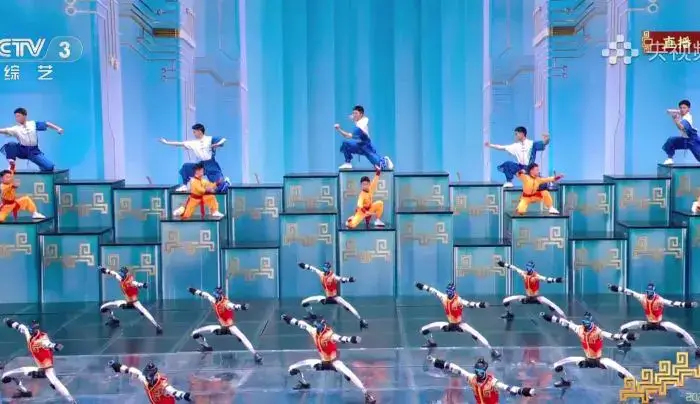
A musical segment featuring Taiwanese artists, combined with the integration of robots into traditional cultural aesthetics, prompted reflections on shared heritage. Some netizens emphasized cultural and historical ties across the Taiwan Strait, calling for mutual understanding and renewed connection. Influencer “Guan Zhang” 馆长, after witnessing mainland robotics technology firsthand in Shenzhen, remarked that the technological landscape felt like “a different world”, encouraging people in Taiwan to see it for themselves rather than rely on secondhand impressions.
Yet not all responses were celebratory. Some insisted the robots were operated by humans in disguise, enhanced with digital effects, or dependent on smuggled chips. Others seized on a moment in which a robot appeared to stumble, claiming it proved technological weakness, despite explanations that the moment had been intentionally designed as part of the choreography. Taiwanese blogger “Liu Jie Ke” 柳杰克 parodied these reactions, suggesting that critics, unable to challenge the technical achievement directly, resorted to dismissing it as fake or aesthetically unconvincing.
A handful of commenters linked the robotics display to military implications, asking anxiously whether such machines might one day appear on battlefields. Similar mixed reactions surfaced in Japan, where some netizens acknowledged China’s technological lead while others emphasized that Japanese robotics remains focused on peaceful applications.
Beyond Taiwan and East Asia, the performance quickly gained traction on global social media platforms such as X. Viewers analyzed the footage frame by frame, debating its authenticity. Comparisons were drawn to Tesla Optimus, with some users joking that Elon Musk’s humanoid robot was “still learning to walk”. In Silicon Valley, industry professionals reportedly questioned how China could achieve such results with comparatively lower costs. According to coverage by Kan Kan News, the gala’s directors emphasized that the robot performance was designed to showcase China’s industrial and technological achievements in a multidimensional way, particularly in motion control and coordinated group operations, areas said to place Chinese robotics among the global front ranks. E-commerce data indicated that within two hours of the broadcast, robot-related orders surged by 150%, reaching more than a hundred cities.