
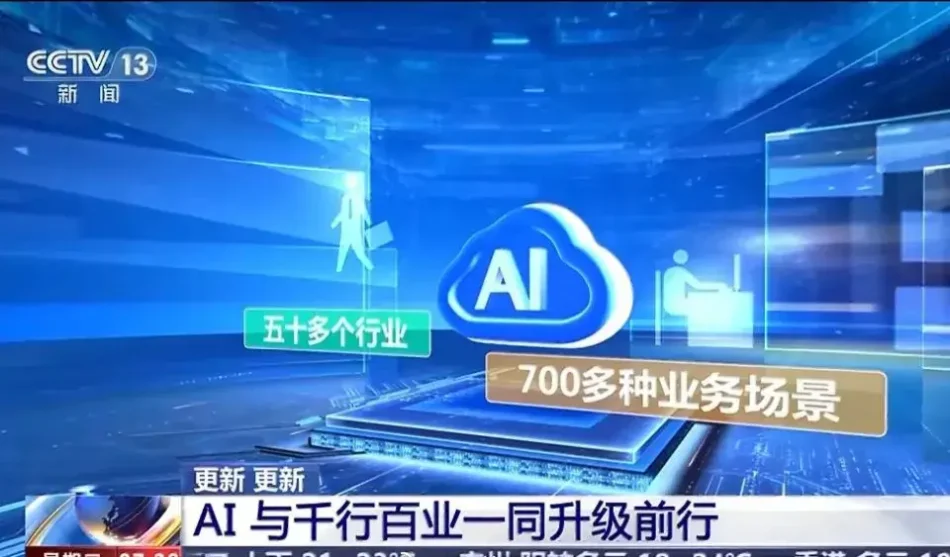

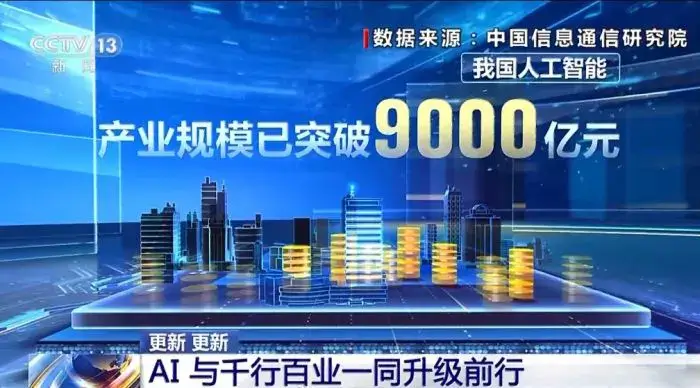
China’s artificial intelligence industry has surged past 900 billion yuan in 2024, a milestone driven by the rapid expansion of real-world applications and the increasingly coordinated development of the entire AI value chain. With more than 700 million mobile users and deep penetration across over 50 industries, the country’s massive user base has become one of the key engines powering this growth.
China’s core AI industry grew 24% year-on-year to exceed 900 billion yuan, and projections suggest it could reach 1.73 trillion yuan by 2035, taking more than 30% of the global market. China is home to more than 6,000 AI companies, three times the number five years ago, and accounts for about 15% of global AI firms. The country also leads in several cutting-edge domains: it holds roughly 60% of the world’s AI-related patents, ranks second in total computing capacity, and has become a global powerhouse in humanoid robotics, with half of the world’s related companies located in China.
AI systems now enhance productivity and accuracy in a wide range of industries: cancer screening accuracy in medical diagnostics has improved by more than a third, and manufacturers have cut production line switching time from hours to mere minutes. The number of AI applications exceeded 650 in 2024, marking a 60% jump from the previous year. User engagement on mobile platforms is soaring, and nearly 90% of domestic users prefer Chinese-developed AI services, reflecting both technological progress and competitive pricing.
The cost of training large AI models has plunged from around 8 million dollars two years ago to under 1 million today, while domestic AI services are frequently available at one-fifth the price of international alternatives. Companies are also accelerating efforts to reduce reliance on imported high-end chips by developing large mixture of experts (MoE) adapted for domestic hardware.
Nevertheless, bottlenecks in chip technology and network transmission speed still limit performance, and the shortage of high-end AI talent, estimated at four million, continues to constrain the sector’s expansion. Commercialization trails behind technological progress, with some enterprises struggling to monetize large models, and error rates in critical sectors such as finance and health care remain a concern.
China is pursuing a strategic agenda aimed at strengthening the digital infrastructure and opening new frontiers. The national supercomputing internet has connected hundreds of service providers to optimize resource sharing, while projects such as “East Data West Computing are designed to balance the distribution of computing power across regions. Emerging fields like low-altitude aviation, embodied intelligence, and edge computing are rapidly gaining traction, with forecasts suggesting that on-device AI alone could exceed 1.2 trillion yuan by 2030. At the same time, AI-powered visual effects and cross-border e-commerce tools are accelerating China’s digital exports.
Across China, 11 national pilot zones for innovative AI applications have been established, and districts such as Haidian are investing heavily, over 1 billion yuan annually, to subsidize computing power and foster enterprise growth.
These forces paint a picture of an AI industry entering a phase of both scale and depth, where technological breakthroughs, industrial collaboration, and policy support combine to shape one of the world’s most dynamic innovation landscapes.