
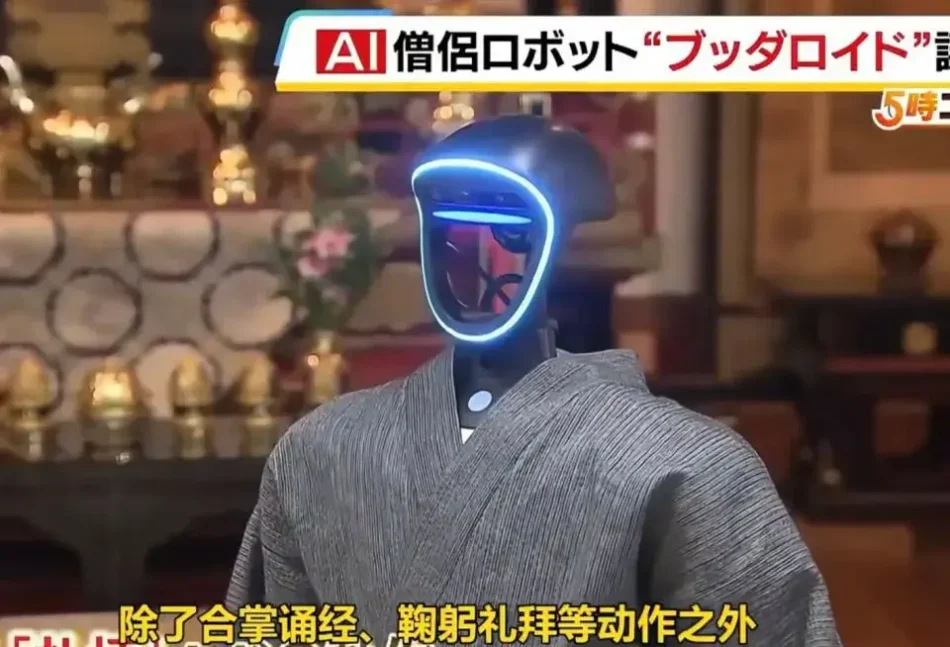

Researchers at Kyoto University in Japan have sparked international debate after modifying a humanoid robot into what they describe as a “monk robot”, intended to help address a growing shortage of clergy in a rapidly aging society. The project combines hardware from the Chinese robotics company Unitree Robotics with conversational capabilities powered by ChatGPT, producing a hybrid system that can perform simplified Buddhist rituals and interact with visitors seeking spiritual guidance. While the initiative has been presented as a technological response to demographic pressures, it has also ignited controversy over cultural authenticity, technological attribution, and research ethics.
The robot is based on Unitree’s G1 humanoid platform, a Chinese-made machine from one of the world’s largest producers of quadruped and humanoid robots. Researchers reportedly equipped the robot with software allowing it to clasp its hands in prayer, bow, and chant Buddhist scriptures. Its conversational system is driven by ChatGPT, which generates dialogue based on Buddhist teachings, including texts drawn from Indian scriptures used for training prompts. The team claims to have programmed more than 300 standardized religious gestures and intentionally slowed the robot’s walking speed to around 20 to 30 steps per minute to create what they call a dignified, ceremonial gait consistent with temple traditions.
According to the project’s proponents, the goal is to provide spiritual assistance in a country where religious institutions are struggling with a severe demographic imbalance. Japan’s population is among the oldest in the world, with more than one-third of citizens over the age of 65. Many Buddhist temples face declining numbers of monks willing or able to carry out daily rituals, funeral services, and community counseling. The researchers suggest that robots could help sustain religious practices in communities where human clergy are scarce, and some have even proposed that such systems might eventually assist in leading ceremonies.

However, the project has triggered intense debate online and among scholars. One major criticism centres on technological attribution. Some commentators argue that Japanese promotional materials emphasize domestic research while downplaying the Chinese origin of the robot’s hardware, raising accusations of blurred credit for the underlying technology. Critics note that similar controversies have emerged before when imported technological components were reframed as local innovations in other countries.
Another controversy involves the perceived dilution of religious meaning. Because the robot’s responses rely on AI-generated dialogue, skeptics worry that complex Buddhist philosophy may be reduced to formulaic phrases. Critics argue that spiritual guidance traditionally relies on lived experience, meditation practice, and personal mentorship, qualities that a machine cannot genuinely replicate. Some observers contend that turning Buddhist teachings into algorithmically generated exchanges risks transforming religious tradition into a form of cultural performance rather than authentic practice.
Some commentators speculate that the project may partly be an attempt to generate global attention in the competitive robotics field by presenting a cross-disciplinary “world first”. By combining imported hardware, advanced language models, and religious applications, the initiative creates a striking narrative that could help attract research funding and public interest. Others argue that such experiments still have value as explorations of how robotics might interact with social institutions beyond industrial settings.
In Chinese online discussions, responses range from criticism of what some view as cultural misrepresentation to humor about robots being “sent abroad to work as monks”. Within Japan, reactions are more cautious. Some people view the idea as a practical way to keep temples active despite demographic decline, while others remain uneasy about replacing spiritual leaders with machines.
Chinese robotics manufacturers like Unitree have gained increasing recognition for their advances in motion control, affordability, and large-scale production. Meanwhile, research institutions in other countries are experimenting with new applications for humanoid robots, often focusing on social or symbolic roles rather than purely industrial tasks.